
By Ken Cleveland
Landmark Correspondent
RUTLAND — Setting out on his bicycle from Rutland in May 2022, Michael Lussier took 323 days to make it back home.
Riding the country, he saw things at a slower pace.
“In my last couple of years at work, I tossed around the idea of how cool it would be to ride across the country,” Lussier, 57, said. “I always wanted to see California. As time went on, it started morphing into what it would be like to ride the perimeter of the country. I mean, if I’m thinking about this, why not go whole hog?
“I’ve seen and heard of hundreds of people who’ve done coast to coast, but how many doing the perimeter? Not many, I would assume; so I decided that’s what I wanted to do.”
Lussier had time after retiring. That gave him a chance for a bike ride very different from those he took growing up in the 1970s.
He had joined the National Guard at 17, and ended up also working for the Department of Defense for 32 years. When he came back from a deployment to Iraq in 2009, he worked at Devens, retiring in 2022 at the age of 56 as deputy superintendent of the Combined Support Maintenance Shop.
“I tell everyone I’m not a cyclist. I’m just a guy that had a lot of time on his hands and went for a long ride. And it’s true, I’m not a cyclist, or a cyclist you think of in the context of a 10,000-plus-mile tour. I didn’t spend hours in the gym or days listening to the Rocky theme riding through the pouring rain trying to hit the 100-mile mark,” Lussier said. “I just went for a ride when I felt like it, maybe 20 miles or so, a couple times a week, and after a shower, planned a ride that would forever change my life.”
The bike trip took many roads, traveling along with cars and trucks.
“Using highways isn’t just for cars,” Lussier said. “In Montana, I rode the interstate and got some crazy stares. On a road that’s marked 80 mph, it’s shocking to see a bicycle doing maybe 15.”
The bicycle gave him a different perspective from that of a car trip.
“Traveling by bicycle … was by far the most immersive experience ever. The world at 12-15 mph is a different place, and time slows down with your speed. You hear things that drive you crazy. The sound of the guardrails on the side of the road expanding as the sun heats them is a long groan, with a ping and a crack here and there.
“The smells are intoxicating. I rode by lemon tree groves in California, and I thought I was near a Pledge factory. The fields of lavender in North Dakota made all the pain so worthwhile; it was like breathing a feeling of total peace and contentment. And the sights … . A quick story. In Montana the ranches go for miles, and the farmers put pesticides down to keep the grasshoppers from destroying their crops. Because of this the grasshoppers sit alongside the road, getting the sun, in a swath about 3 to 4 feet wide. As I passed them, they launched themselves out of the way, starting about a foot from my front wheel out to about 3 feet. They looked like rows of Chinese firecrackers going off in front of me, for mile after mile,” Lussier said.
“Traveling by bike is an all-out assault on the senses, and it’s so overwhelming, it seems impossible for the brain to process, hour after hour, day after day. Remember your last weeklong vacation? Multiply that by 50 and try to process it. … To this day, I’m still enjoying it, and I swear I can still smell every mile I think about.”
Going back to the question of ‘Why?’, Lussier said he wanted to do something different.
“I wanted to do something that would be different, something only a lunatic would do. Not to brag or gloat, but just because. It would be something that tested me. When I told people what I wanted to do and how long to do it, they would say, ‘You’re nuts.’ That’s when I knew I had to do it. And come on, now when I’m with a group of people and some start out with, ‘I went surfing in Maui’ or ‘We went hiking in Yosemite,’ it’s always nice to pull out of my pocket, ‘I spent 323 days living on a bike and rode the perimeter of the U.S. by bicycle.’ That wins first prize most of the time,” Lussier said. “And I’m proud of that.”
It took a lot of work just planning the trip. Nonetheless, “Planning and preparing were my favorite parts.” He said he gathered maps that included places for cyclists to stay.
“I downloaded them into my Garmin head unit on my handlebars, and just went. For 3,000 miles I was good to go, direction-wise that is. The Garmin head unit is a computer that tracked all my data and had GPS, so I just turned it on and it told me where to go.”
He had gotten the best equipment during two years of preparing for the trip.
“My life depended on it, and I was in no way skimping on my gear,” Lussier said.
“I knew it was going to be brutal on my body, but the mind was the part that would be taking the biggest brunt of it. I was going to be alone, rambling around the country for a year by myself. Preparing for loneliness is impossible, so I crossed those bridges when needed.”

Lussier said it would take hours to talk about what he saw on the trip.
“Every day was like living in another world,” Lussier said. “The views along the Pacific Coast Highway were amazing, beautiful, at times indescribable. Crossing the Golden Gate bridge brought such joy. The redwoods were just majestic, the desert was an experience like no other, the colors changing with the orbit of the sun and the coyotes howling all night.”
“The hundreds and hundreds of miles of corn in the Midwest, draining the sanity out of me in 95-degree heat, the field of dreams in Iowa, the inviting east coast of Texas, with the smell of petroleum while living on the beach for eight days, the Rockies and the Cascades, mountain ranges that tried to beat me into submission … the sky in Montana, the most incredible night sky I have ever seen brought tears to my eyes,” he said.
From poverty to opulence, to wild animals, mechanical issues and people who helped and the traffic, he saw the country as he traveled through it.
Lussier doesn’t have to describe it all; he collected his journal and 1,000 photos into a 720-page book titled Keep the Lonely Places Lonely.
He kept in touch with people back home as he traveled. He said his family’s support kept him going, including that of his ex-wife and son and daughter, and now a granddaughter.
“They are amazed at what I accomplished, but I hope they take away from it that the only thing holding them back is themselves. They love the stories I tell now, and my daughter’s eyes are glazing over with dreams of adventure,” Lussier said.
He has advice from his experience: “Explore. Don’t just find a new place — find you. Don’t be afraid, have faith in you and your capabilities. Doing something like this changes you … in ways you’d never expect. You’ll never be the same.”
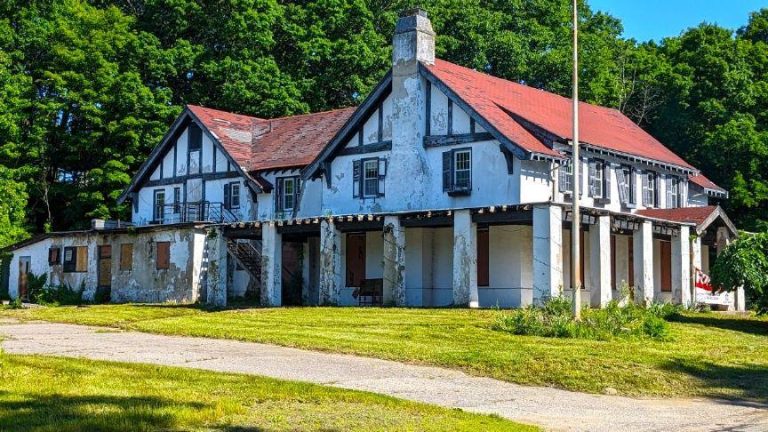
Lussier’s book got its title “from an abandoned building I had passed in Lobo, Texas. I was on a long desert road in the middle of nowhere and came across this mess of a structure, all beat up and forgotten, where someone had painted ‘Keep the Lonely Places Lonely’ in block letters on the front. It seemed so fitting.”
After almost a year and thousands of miles, Lussier came back with a perspective on people.
“We live in such a divisive age now, we’re all bogged down and numb by events socially and politically, that it’s nice to escape it all and just pedal. Go somewhere, anywhere. Use the power of you to get there, and you’ll find we live in a paradise that has so much to offer.
“The guy helping you with a flat or mechanical issue may not be on the same wavelength as you, but for just a few minutes, you can come together and see eye-to-eye and appreciate the person next to you … . Those are the things we need to pay forward. Unplug for a bit; all the crazy will be waiting for you when you get back, promise,” Lussier said.