
STERLING — Town officials will be meeting with representatives of downtown businesses and organizations after they packed the June 7 meeting to protest parking changes brought on by recent line painting.
A couple of weeks ago, the town painted new lines on Main Street and the roads around the town common, designating legal parking spaces. That, business owners and church representatives said, has negatively affected people.
For their part, officials said the painting more clearly defined already legal — and illegal — street parking, despite usage. Some of the no-parking spaces were designated as such to make sight lines easier for cars at intersections and people in crosswalks.
But there might be ways to make things better; Select Board Chair Maureen Cranson was set to meet this week with town employees and representatives of those upset with the parking to come up with some longterm solutions.
The downtown revitalization project first surfaced in 2007, and the town worked with engineering firm Weston and Sampson to develop plans for the upgrade of sidewalks and roads. The plan has been dragged out a few times over the years, before Weston and Sampson was contracted to update the plan in 2021 to include ADA ramps for sidewalks, adjusting the road and maximizing parking.
According to the town’s fact sheet, in 2022, the town administrator and the Select Board applied for and received grant funds to add work to the engineering of downtown to include water main replacement engineering and to fix stormwater flow in the downtown region, which is ongoing.
In 2021, the previous town administrator and planner received grants through the state of about $170,000 to begin making some of the changes, the major one being to curb in the “green area” at the bottom of Meeting House Hill Road, creating a 90-degree intersection for traffic calming. However, this plan was determined to affect stormwater runoff, so was abandoned.
According to the fact sheet, the DPW director and town administrator discussed options for re-use of the funds in the parameters of the grant; with board and state approval, the town moved forward with a downtown parking layout to safely maximize parking.
The plans were completed in October 2022, and the plans were reviewed and approved by the DPW and Select Board on Nov. 9, with a goal to complete the work before Memorial Day 2023.
In addition to delineating 50 onstreet parking and two dedicated handicap spaces, fire lines were added in front of the First Church and along the side adjacent to the library, as discussed starting in 2019.
In the future, plans will be received from Weston and Sampson that will show parking areas, changes, curbed areas, new ADA sidewalks, buried utilities, stormwater and water main upgrades. According to the fact sheet, the town will look into additional parking on Cross Street, and areas will need to be paved and lined for consistency.
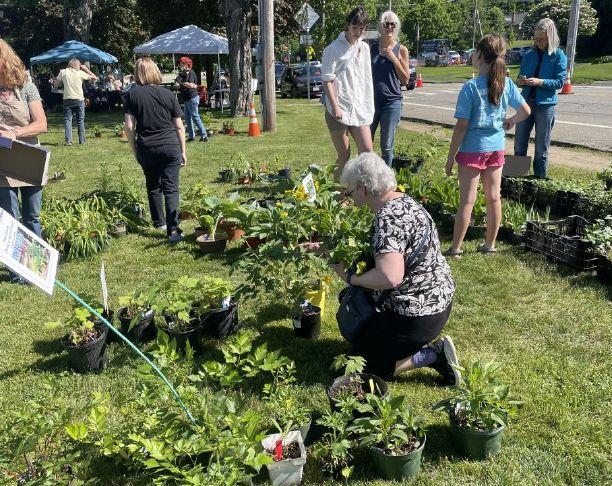
“The town will also look into options regarding the Sterling Street Market on Saturdays,” according to the fact sheet. This past Saturday, a quiet day for the market, there was parking around the park and in the Butterick lot.
The group submitted 30 impact statements from businesses and organizations in the downtown area.
Andrew Bluestein, owner of Emma’s Café, represented the business owners and organizations at the meeting. He said one of the reasons he relocated his 8-year-old business from Stow to his hometown of Sterling was the parking accessibility, as well as promises of economic development.
“I am deeply concerned with the recent parking changes and how it is impacting our customers’ ability to access all our businesses and our ability to succeed,” Bluestein said. He said it is particularly bad on Saturdays, when the Sterling Street Market is busy and his restaurant is serving hundreds of customers, and Sundays, when church is being held and he is also attracting customers.
“It is vibrant, it’s great, it’s what I moved my business here for,” he said. But he has been forced to be a traffic attendant, with people finding parking where they can, and some customers driving around, then leaving when parking is not available.
Bluestein said he has asked his employees to move from parking on Maple Street to the far end of the Butterick Building back parking lot, but that is only a couple of spaces.
In her statement of impact, First Church pastor Rev. Robin Bartlett said they were “completely caught off guard by the town subtracting more than half of the parking in front of our church and more than half of the parking spaces in the area around the common.
“Our 400-member church, preschool, theater, rentals and the many town and civic organizations that use our large parish hall count on all usable parking spaces around the common and behind the town hall to function normally,” she wrote. “The area business owners and nonprofits all had testimonies of disabled, elder and children patrons who could no longer enter their business easily or at all … . Derek, of Woody’s Barbershop, had to cut a disabled person’s hair on the street because he couldn’t park near the shop.”
Bartlett wrote that the church had to recruit a team of parking attendants on the Sundays of May 28 and June 4, and for the community lunch on Saturday, June 3. “One of them fell down and gashed her knee open on the sidewalk on May 28. One of our members in a wheelchair couldn’t get out of the car because one of the new handicap parking spaces abuts a curb.”
Cranson said some things can be solved short term, adding she knows first-hand that drop-off parking at Village Green Preschool was never fun, even when she dropped off her own children, but that while the spots were “never legal,” parents can quickly stop to get their young children inside.
Police Chief Sean Gaudette admitted that officers have been there to check, but said they cannot have someone stay there for a long period to see who is “standing” vs. parking for two hours.
Cranson also said during funerals, there would be consideration given to make sure the hearse can park near the church to make it easier.
Many of those in the audience disagreed with board members Kirsten Newman and David Smith that the line painting made it safer for pedestrians, saying it has done nothing to solve the speeding, which they said is the major safety problem in the area.