

HOLDEN — When Royce Singleton retired, he finally had time to look through copies of letters from World War II.
The correspondence between his parents, Becky and Royce Singleton, captured a 13-month span while his father was a Navy fighter pilot in the Pacific theater.
“I knew that he fought in World War II, but I did not know anything about his combat experience. Like so many veterans, he never talked to me or my siblings about the war years,” Singleton said.
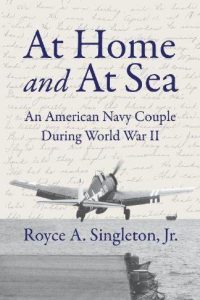
But the letters formed the basis for a book, At Home and at Sea, that showed the life the couple lived separated by distance and war, focused on the servicemen who fought the battles at sea and the families who fought to hold things together at home.
“Both were born in 1921,” Singleton said. His father died in 2002 and his mother in 2005.
“I’m not sure when I was first aware of the letters. My parents gave them to my sister when they were in their 70s. She gave them to my youngest brother, who made pdf copies and downloaded them to a CD to share.
“I did not start reading them in earnest until I retired in 2009. I was inspired to tell their story after reading over 200 letters that they wrote to one another during the war.”
A professor emeritus of sociology at the College of the Holy Cross, Singleton has academic publications to his credit, but this is his first book for the mass market.
“We have copies of about 500 letters that my parents wrote to one another in the first 20 years of their married life. At first, I planned to use the letters to write a family history. I began by reading letters written in the 1950s, when I was old enough to have a more complete knowledge of family events.
“When I got around to reading letters from World War II, I realized how little I knew about this time in my parents’ lives. I saw in the letters a love story of a couple living apart and maintaining a relationship under the stresses created by the war. I also saw that I did not fully appreciate what they had been through,” Singleton said.
The book gave him a chance to tell their story.
“The purpose of the book is not to contribute to the vast literature of naval history, with its focus on major battles and the actions of a few ‘great men’ — admirals, generals, presidents. These accounts omit the everyday lives of millions of people like my parents, caught in the sweep of history. We cannot truly understand war without considering the experiences of so-called ‘ordinary people.’ I therefore hope that readers will appreciate the sacrifices made by the men (and women) who answered the call to serve and the families they left behind,” Singleton said.
“The letters contain almost no information about my father’s combat experience. Censorship of letters prevented him from revealing where he was or anything else of value of the enemy. As the saying went, ‘Loose lips sink ships.’ Because of this constraint, my father sometimes wrote ‘there is no news the censor would pass’ or ‘I’ll tell you all about it when I get home.’
“While my father was at sea, my mother was living at home in Oklahoma City, pregnant, working, managing the finances, preparing for childbirth, then becoming a mother, all while planning for a future with her newlywed husband. My mother’s letters are filled with details of her daily life: Preparing and eating meals, getting together with friends and family, seeing movies, playing bridge, shopping, visiting the doctor, and caring for the baby. For the first few months, she writes about her office job; then, after she quits working several weeks before the baby is due, almost every letter expresses her eager anticipation of the baby’s birth, as she repeatedly experiences false signs that the baby will arrive ‘any day now.’
“The impact of the war on the home front is revealed as my mother describes rationing, the housing shortage, her investment in War Bonds, her father’s Victory Garden, and volunteering at the U.S.O.,” Singleton said.
“My parents had been married for seven months when my father went to sea. They were still adjusting to one another as marital partners, and their letters reveal areas of conflict, especially regarding my mother’s financial management. Overriding these disagreements, however, were continual expressions of endearment, which became longer and more poignant over time. As the time passes, both of them repeat the same sentiment, ‘I love you more and more.’ ”
His mother’s fears for her husband, and her future, were evident in the letters.
“Wives of servicemen could not help but be anxious about their husbands, as they lived in fear of losing the person they loved. … When my mother did not hear from my father, she sometimes openly expressed her anxiety and fear. Yet, she always followed this by telling him that everything would turn out all right. At one point, she wrote, ‘If I shouldn’t hear from you before the baby comes, I won’t worry, darling, ‘cause I just know everything’s going to be all right and I don’t want you to worry over me, hear? The baby and I are going to be OK, too.’
“Neither of my parents wrote about the importance of the war effort in their letters,” Singleton said.
“At one point, when my mother cannot join my father in San Diego when he briefly returns to the States, she wrote, ‘War is hell, isn’t it? I’m getting hard as nails, I’m afraid. Every time I hear some ‘doting mother’ so afraid her little boy is going to be drafted or doing her best to keep him on this side, I feel like letting her in on a few things. And those draft dodgers — how I hate them!!’
“My father enlisted in the Navy a month after the Japanese attack on Pearl Harbor. But eight months into his tour, after most air groups have returned home, he implied that he had done his share, and that it was someone else’s turn. As he wrote, ‘We’ve all had about all we want of this stuff for a while.’ ”
Singleton’s father’s ship and air group took part in the Central Pacific offensive, a series of battles at atolls and islands spanning 3,300 miles, from Tarawa Atoll in the Gilbert Islands to Leyte Island in the Philippines, where U.S. and Japanese forces engaged in the largest naval battle ever fought.
“My father served on an escort carrier, U.S.S. Suwannee, whose primary mission was to provide combat air and anti-submarine patrol to protect the fleet. During amphibious landings, his fighter squadron also often strafed enemy installations in support of ground troops. Although fighter squadrons aboard the larger fleet carriers were far more likely to engage the enemy in air combat, the Suwannee fighter squadron did occasionally intercept and destroy enemy aircraft. My father was the ace of the squadron with 3.2 shootdowns,” Singleton said.
As he put the book together, “I realized that the experiences of both my parents revolved around the Central Pacific offensive … . I therefore chose to make the Pacific War the integrative narrative for the book.”
Singleton drew upon several naval histories to describe major battles.
“To recount my father’s participation in these battles, I used an oral history of my father’s air group, memoirs written by two of his shipmates, and official operations records maintained by all Navy units during the war, which are accessible in the National Archives.
“To describe my mother’s experiences, I relied almost exclusively on her letters … carefully selecting excerpts that captured key events and themes,” Singleton said.
His proposals for the book were rejected by a half dozen publishers, he said, and he decided to self-publish. He had co-authored textbooks published by Oxford University Press.
But all the publishers who rejected At Home and At Sea conveyed the same message, he said.
“They did not believe there was a big enough market for the book to justify publication. I believe I eventually would have found a traditional publisher; however, I did not want to wait any longer to see the book in print.”
He has seen positive responses, including on Amazon, where the book is available.
But more importantly, the book captures an important time in his parents’ lives, and in the nation at war.