
The solar eclipse April 8 lived up to its billing here in New England. I was fortunate enough to be able to make the 3-hour drive north and be in the path of totality, which only lasted about three minutes but was inexplicably amazing. Temperatures cooled, winds died and things went quiet, but for a barred owl that hooted, and the darkness was very unlike the sun going down. Some said it was “eerie.” I just thought it was amazingly cool.
We looked at the sun with binoculars during totality (the only time safe to do so) and could see solar flares bulging from the sun’s surface. The many amazing pictures from the event that people took showed sunspots, dark areas of cooler temperature on the sun’s surface that can emit magnetic energy.
When conditions are correct and those sunspots are pointing at the Earth, that magnetic energy can come streaming toward Earth, and when it enters the atmosphere can create amazing colors in the atmosphere known as Aurora Borealis, aka Northern Lights. This occurred the weekend of Mothers’ Day (May 9-11), and many of us got to see this spectacle of nature that more often only occurs near the North or South Pole, where the magnetic radiation enters Earth’s atmosphere. Because the recent sunspots were so large, the resulting auroras were seen as far south as Florida and Puerto Rico, which is rare. Many of us also got to learn something about the physics of photography, when our phones captured images even more colorful than our eyes were seeing.
This was only the second time in my almost 60 years that I have been in the correct place at the correct time with clear enough skies. The other time was 20 or so years ago when I was still teaching, and I remember making a big deal of this with my students. One student asked, “What is the big deal about all this?” The best I could come up with was, “Every night when I look up I either see grayish nothingness or black with the speckles of the stars; it will be cool if it is pink, purple and green.” I have wondered for a long time if this was what Jimi Hendrix had seen when he wrote Purple Haze. The other astronomical delight, at least for me, this time of year are sunsets after 8 p.m. We will not see sunsets before 8 p.m. until sometime in August.
We are seeing plenty of flowers this May. Winter made that late inning rally in late March and early April, but it has been otherwise warm and rainy. I like when Easter falls early, as many local shops sell pansies, which are hardy against our cold and can offer some early flower color around the yard. I like to get them started early so that by the time late April and May come around, they are off and running.
Many of our annual flowers should not go in until the third week of May, and many from my parents’ generation say Memorial Day. It has become a tradition for many to get them in the ground around Mother’s Day, and with the trends the last couple of decades toward warmer temps, this usually works out. Last year a late hard frost (May 18) destroyed the peach blossoms and many early tender leaves on trees and shrubs throughout the state. Local wildflowers, often referred to as Spring Ephemerals, along our walking and hiking trails and in our yards made (and still are making) a nice showing. These flowers, such as starflower, trillium, violets, bloodroot, wild oats and many people’s favorites, lady slippers, bloom before the trees are fully leafed out, taking advantage of the sun reaching the ground before the leaves of summer will block it. Each year my wife reminds me that I always say, “The leaves will be fully out by May 15”. This year in Rutland it seemed it was May 17, but all you have to do is go down in elevation into Holden and Worcester and they were out and green a week before that.
Late April and early to mid-May are when the majority of migrating birds return, with some only passing through heading farther north to breed. I spent numerous days this spring at Adams Farm in Athol counting migrating raptors (hawks, eagles, falcons and vultures), the way I did last fall atop Mount Wachusett. The Hawk Migration Association of North America has a site here for spring migration raptors. This year nearly 3,000 raptors were recorded. I was there one day when we saw hundreds of broad winged hawks returning and passing through. We also saw many bald eagles, ospreys and turkey vultures, all which are experiencing greater numbers, showing that conservation efforts work.
By May 1, Baltimore orioles, rose breasted grosbeaks, house wrens and catbirds were singing in our yard, and the orioles were visiting the bowl of grape jelly we put out for them. More and more people are putting out hummingbird feeders, which is great news. There are Instagram and Facebook pages dedicated to tracking their progress north, and by the end of the first week in May, friends and family were seeing them and we had our first one visiting flowers in our yard. By the end of May/first week of June, any bird species we see in the area can be presumed to be a species that breeds here, not just one passing through.
Every year for 40-plus years, a breeding bird census has been conducted at Wachusett Meadows Audubon sanctuary in Princeton. Similar to the Christmas Bird Count and Hawk Watch, this provides an ongoing database of the species and number of each at that location. Several species that prefer cooler temperatures are no longer seen in the numbers they used to be, or at all, and other species once uncommon in our area have moved north, such as Carolina wrens, red-bellied woodpeckers and turkey vultures. Some species, such as black billed cuckoos and yellow billed cuckoos are more common in years that we have greater numbers of gypsy moth caterpillars around, as they are one bird that doesn’t mind eating hairy caterpillars. Members of the Forbush Bird Club are now assisted by members of the Ware River Nature Club in conducting this event. Ware River Nature club members have been maintaining bluebird houses and keeping records of breeding success in the Rutland Prison Camps and other areas. Bluebirds eggs and hatchlings are already in place as of this writing, and tree swallows, which use some of the boxes, are also on nests.
Featured Flora and Fauna
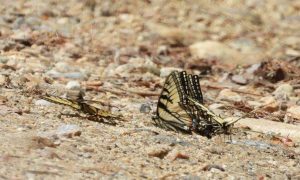
Eastern Tiger Swallowtail Butterfly. For the most part, the hotter and sunnier the better for seeing butterflies, which is why the annual butterfly count is in July. One of our largest, most colorful and regularly seen butterflies is the Eastern tiger swallowtail. From a distance, it is mostly yellow with a black trim on its wings. If you get a close-up view, you can see a beautiful pattern of blue and orange spots as well as the long “tails,” extensions of the wings, for which they are named. Often mistakenly called monarchs, probably because of their size and similar color, though upon closer examination they are clearly yellow versus the orange of monarchs.
Tiger swallowtails, unlike some butterflies, are seen regularly from the first warm days of spring until the last warm days of fall. In our area, they will have two broods each year, meaning a full life cycle of egg, caterpillar, chrysalis and butterfly occurs twice. The caterpillars also will favor a variety of plant leaves as food, unlike some caterpillars of other species that only eat leaves of one plant species. The adult swallowtails also visit a variety of flowers, such as lilacs in the spring, milkweed in the summer and Joe Pye weed and asters in the Fall.
Tiger swallowtails and other butterfly species can often be seen in small to large groups near muddy little puddles on sand and gravel roads or even piles of animal dung. They do this in sunny areas, and a little research tells me they are after moisture, salts and other minerals that keep them thriving. In early April when my wife and I visited family on Lake Anna in Virginia, we saw puddling tiger swallowtails on the shoreline. This past week I saw a dozen or more doing the same on Coldbrook Road and Prison Camp Road. Like other insects that feed on nectar and pollen from flowers, they act as pollinators, which help our plants reproduce.
What to do:
The morning bird or dawn chorus is at its peak. Birds, especially robins, will begin singing by 4 a.m. and be joined by numerous other species, including warblers, thrushes, phoebes, chickadees and cardinals. Often many of them quiet down soon after sunrise, though a few, particularly red-eyed vireos, wood peewees and chestnut-sided warblers keep at it all day long. I have enjoyed this time even more the last couple of years using the Merlin app from Cornell University that helps identify bird songs through my phone. It is not infallible, but amazingly accurate. On any given morning the last two weeks I can (with Merlin’s help) easily hear 10-12 different species from my deck alone.
Fishing season is cranking up quickly. My son Tanner and I got to try two new “early” season experiences this spring. In late April we trekked out to Lake Ontario just west of Rochester, New York, with his buddy Austin Hale, and went fishing for brown trout and king salmon. We caught some amazing fish, salmon to 18 pounds and trout to 8 pounds, which made for some excellent eating. My son also managed to get a steelhead rainbow trout in Oak Orchard Creek. It was almost 30 inches long, and put up quite a battle on light spin gear. We also got down to Cape Cod early for the annual squid, calamari squid, run in Nantucket Sound. With fellow Rutlandite Brian Ford, we spent a chilly but productive evening catching squid outside Hyannis Harbor with old friend Capt. Rob Lowell of Cape Cod Offshore Angling. We fired them, sauteed them and baked them, all of which were delicious. Currently striped bass are back in saltwater from coastal Connecticut to Boston Harbor, and I am sure points north. Black sea bass season opened May 18 and should pick up in the next few weeks. Be sure to check online regulations for these and all species, as they have changed. Freshwater fishing in local ponds is also strong. Bass are or soon will be on their beds, trout are still available thanks to recent rains, as well as pickerel, perch and sunfish in local ponds.
Locally things are green and blooming along local trails and backroads. Get out and enjoy! Black flies have been pretty thick and will soon be joined by mosquitos, so cover up. We have found ticks to be out in full force as well, so tuck your pant legs into your socks and check yourself when you get home.