
PAXTON — One may happen upon 19th-century stone markers that are the equivalent of an 1828 “Entering Paxton” sign, particularly while perambulating the borders of the town.
Eric Howe did just that, traipsing through woods, swamps and underbrush to track down the 26 border markers, or “Witness Stones.” He was helped by a 1908 book detailing the locations of those markers in Massachusetts communities.
“I was able to locate all 26 stones,” Howe said, with 25 detailed in the book Finding Paxton.
He took a friend’s suggestion to investigate the “witness” stones of Paxton.
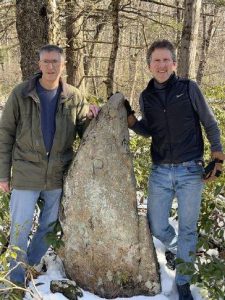
“After doing some research about the history of New England perambulation (the tradition of witnessing the town border stones), I essentially took on the task … (locating) each of the 26 stones that delineate Paxton’s unusual boundary,” Howe said.
Most of the markers required a good deal of woodland trekking.
“The easiest stone by far was the H-P 5, which is located beside the road on Grove Street,” Howe said of the marker that piqued his curiosity.
“‘Is that a tombstone?’ I said to my wife one day almost 20 years ago, when we had first moved to this area. We were going for a walk one afternoon, and there in plain sight within the border woods, perhaps 10 feet off the roadside, was a large flat stone with faded writing on it,” Howe records in the book.
The rest of the markers were not so easy to find.
Howe did not just make a list of the markers, however. He gave readers a narrative of his tracking adventures.
“I’d like to think most people enjoy a story, and in this case, the small histories of the various locations where the stones reside (the homesteaders, the fields, the mills, the abandoned roads) are the bedrock of the legacy for anyone who calls Paxton home,” he said.
Using the old records and a new GPS, he set out, learning that even GPS using the old coordinates needed an adjustment to home in on the stones.
But ultimately, it took looking through the woods, sometimes through brush with decades or more of growth hiding the historical record of early settlers. Although most of the area was once clear-cut fields, former farmland has been reclaimed by Mother Nature.
Most markers are not near homes or obvious private property, but he did avoid going onto private property, thus the single stone that he was able to find but not get close enough to for a photograph.
Having tracked down the markers, he noted the changes over time.
“It is very difficult to imagine how the countryside appeared when the stones were first set in 1828. Part of this is because the town would have been in the midst of a scale of deforestation that is difficult to conceive.
“Still, even in some of the remote areas (e.g., along the fallow Carruth Road or along the old Kendall Road), there were times when I/we would have a general sense of what must have been a fairly isolated life. There, along the abandoned roads, where an old cellar hole rests hardly discernible along the roadside. Imagine the difficulty of farming within the rocky ground, in fields marked by stone walls that have stood unchanged from years ago.”
“We (Howe and his friend Brian Vaugh) would talk to one another — trying to picture a wagon descending down the Carruth toward the Jennison Mills, the activity around the mills once so prevalent there. It must have been a hardscrabble existence in many ways, one dictated by the measured necessities of the seasons.”
Howe said that “the placement of the border stones may have borrowed from their historical use (in England) as delineating parish boundaries. Many of our towns were established under the auspices of having borders that demarked where residents (outlying farms, mills and homesteads) would go to worship.
“Paxton’s own history is reflective of this. Paxton was essentially created by petition (and subsequent formality), as Rutland and Leicester relinquished portions of themselves so that residents could more easily travel to worship (in what became Paxton). I suspect the border markings in some way reflected and even sanctioned this delineation. I am speculating here, but I would hazard that there is a vein of truth to this,” Howe said.
The markers no longer serve their original purpose, but do emerge as a reminder of history.
“Paxton, not unlike many small towns in the state, has a rich history — one that unfortunately is being eroded and forgotten. As ever more land is cleared for development, and as new residents seem less interested (or perhaps indifferent) to the historical story of the people who worked so arduously to carve out a life here, these stones are one of the few enduring monuments that have essentially remained unchanged.
“It is amazing to me to consider that these stones were chiseled when Andrew Jackson succeeded John Quincy Adams as president of the U.S. They’ve stood through multiple rounds of deforestation and succession, through growth and development, and through neglect. They are in every sense a link to our once shared traditions with old England,” Howe said.
The book recounts history and the search.
“Nearly 10 years ago, I kept a daily handwritten journal of my own simple observations. I wrote about the changing seasons, of the pace of life in various places within our town, of the history shared to me by several residents who I had come to dearly know. I ended up transcribing this into a rather large book,” he said.
He never advertised his books, Howe said. “I simply gave them away to people I knew would value them.”
He finally got around to putting them on Amazon not long ago.
“I’ve been humbled by the response. It’s nothing earth-shattering, mind you, but I’ve been fortunate to have some support — with a dose of healthy criticism, too!”
Howe has given talks at Richards Memorial Library and the Senior Center, primarily academic talks about his work with the history of electrostatics.
Howe’s 14 books are a hobby, eight of them a mystery series involving forensic botany to solve various crimes.
“These have been quite rewarding, as they document my own youth growing up” in the Douglas Lake, Michigan, area.
Howe and his wife have lived in Paxton for 20 years; he was a professor of science education at Assumption University for 18 years before retiring.
“My research interests involved the use of the history of science as a vehicle to teach students about what is loosely called the nature of science (how science as a way of knowing is unique from other ways of knowing),” Howe said.
An avid cyclist and triathlete for nearly his entire life, Howe did not realize he was preparing for a new adventure hiking through Paxton’s woods.
“Finding Paxton is a modest collection of the history of perambulation, the challenges of finding the border stones, and accompanying narration of the surprises of hiking nearly 40 miles to get to each one of them,” he said.
And he gained a unique view of Paxton.
“It’s evolving, and I worry that its rural character and history will be forgotten. There are wonderful stewards in the town who share a like-minded view, and I am thankful for this,” Howe said.
Finding Paxton is available at 10 West Market as well as online at Amazon.