
PAXTON — Linwood Erskine Jr. was just a few months old when his parents, living in Worcester, bought a farm on Richards Avenue here, mainly for summer use, since the roads were not paved.
That was in December 1923, before Erskine moved to Paxton as a full-time resident.
A century later, Erskine is still living in Paxton, and he still maintains property, occasionally, as his daughter Louise said he described it, “making land.” That is code for cutting down trees.
Operating a chain saw may make some nervous of a 100-year-old man, but his one real impediment — hearing problems — may simply make the chain saw quieter.
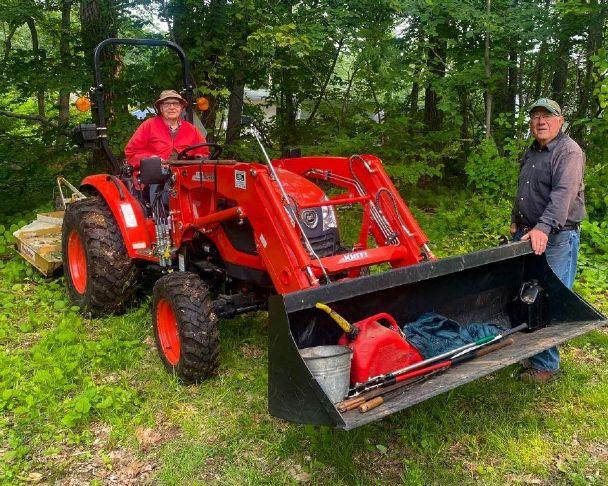
For his 99th birthday, he bought himself a new tractor.
So when Erskine was awarded the Boston Post Cane, which recognizes the town’s oldest citizen, it was not because he was “old” so much as he was the person in town who had seen the most birthdays.
Erskine did more than just live to become the oldest. His life along the way included growing up in rural Paxton when rural was really rural. It included serving in World War II in the 10th Mountain Division, a law career, and service to the community.
And it included a family that he and wife Margaret raised on Richards Avenue.
Being awarded the cane, he lamented that his new hearing aid was not up to the task. But he was, as he addressed those gathered to honor him.
“I consider it an honor to be recognized by the governor and Legislature. It is a bigger honor to be recognized by the town of Paxton,” Erskine said at the Senior Center ceremony Oct. 22.
“Paxton is where I spent more time than anywhere else,” he said.
“I’ve been pleased with what Paxton has done for me,” adding he was pleased with “what I have done for Paxton.”
He had a history to tell.
“I think back to my early days,” Erskine said to those who filled the room. The town was “mostly dairy cows and open land.”
Today there are more houses, he noted.
“I hope the town progresses in the years to come and can be as successful as it has been in my 100 years.”
Erskine said he would be happy to have the Boston Post Cane over his mantle at home, “and I would take good care of it,” though he later decided that he would leave it in the care of the Historical Commission, where it will be on display in a case that lists the recent recipients.
The cane presented is a replica the commission obtained in 2013 of the early 20th-century canes distributed by the Boston Post.
Erskine also received a pin of the cane that he can wear.
He also received the honorary citations, one from Gov. Maura Healey and another from the Massachusetts House of Representatives, presented by State Rep. Kim Ferguson. She added he would likely have one from the state senate, but former Sen. Ann Gobi had taken a role in the administration, so the position was yet to be filled in the coming special election.
As guests enjoyed cake and other refreshments, his daughter Louise chatted with friends and neighbors.
She said her father still drives his tractors, and he and neighbor Jerry Hyson will go out to “create land” by cutting trees with chain saws. She admitted it made her nervous, but there was no stopping Erskine from staying active. Very active.
He had experience growing up in Paxton as well as in the mountains of Italy during World War II, in which he served in the Army’s famous 10th Mountain Division.
Enlisting in 1943 and attaining the rank of sergeant, Erskine was awarded the Bronze Star for his actions in the Apennine Mountains and Po Valley.
Louise said when he arrived home with a beard, his wife greeted him with a nice meal, noting further delicious meals would only be coming if the beard went away.
He has worked the property his father bought. But his career, like his father’s, was in the law, a career his son, Matthew, also entered, working with his father for a time in Erskine & Erskine.
Erskine was active in the community, serving as president of Worcester County Horticultural Society, president of the Worcester Rotary Club and president of Worcester Mechanics Association. In Paxton he served on the Finance Board, the Board of Appeals and the Building Bylaw Committee.
When his parents Linwood and Katherine Erskine bought the farm at 495 Richards Ave., Turkey Hill was mostly open hay fields, with some brush growing along the shore of Turkey Hill Pond, Louise said, adding Linwood’s father planted most of the trees on the hill.
“Long-term residents will remember the many sheep and cattle that he raised over the years, including Highland cattle,” she said.
Though he now lives with her on Brooks Road, Erskine started life in Worcester.
“I was born in August 1923, and in December 1923 my parents bought an old farmhouse and about 118 acres on what is now Richards Avenue,” he said in a narrative of his life.
“The house was the last one before the road reached the Rutland town line. The nearest house was about a fourth of a mile south where the Griffins (number 324) lived.
“In my early memory, the road was a dirt one lane road and was not kept open beyond the Griffin’s house during the winter. My family used the house during the summer and spent winters in Worcester,” he recalled.
“Once each winter we would spend a weekend in the Paxton house, using snowshoes to travel from the Griffin’s house.
“The farm had frontage on Turkey Hill Pond, and we would go swimming almost every day during the summers.
“During the summer, my father would go each work day to his office in Worcester, often on a bus operated by the Clapp family based out of the Paxton Garage on Pleasant Street.”
The single store in Paxton was located where Saint Columba Church now stands, he said. The Rossier Grocery Store was run by Mrs. Rossier, who also ran the Paxton Post Office.
“Our box was number 82,” he recalled. “There was no rural mail delivery. When I returned to Paxton after World War II, there was rural delivery to all of Paxton.
“With a brother and two sisters, we entertained ourselves most of the time, but did participate in programs for town children at the Richards Memorial Library, when it was built in 1930,” he said.
“The then lady librarian had programs in the library basement for making hand-crafted things. My sisters and I would walk the 2 miles to the library; my brother was too young to go.
“My older sister was the money keeper, and had the cash for each of us to get an ice cream cone before walking home. The cones were purchased at a small store run by a lady who I recall as being named Mrs. Foy.
“My next period of memories was at the end of World War II. I served in the 10th Mountain Division and chased Germans in Italy. The division was sent back from Italy to retrain for the invasion of Japan after the end of hostilities in Europe. I was on a 30-day furlough at what is now 495 Richards Ave. when the atomic bombs were dropped on Japan. I was very happy, as this meant the end of the war and an early discharge from the Army,” Erskine said.
He married in 1950, “and a year or two later, my wife and our first child moved to 495 Richards Ave. to live year-round. We had what I called an amateur subsistence farm raising most of our own food, eventually building a barn and farm pond. We had sheep, cattle, chickens and a variety of cats and dogs.”
His wife, Margaret Ayers Erskine, died in 2002 and is buried in Paxton’s Moreland Cemetery. The Erskine headstone by her name reads “His wife, author and flower gardener.”
“My name is above hers and reads Lawyer, Farmer, and Mountaineer, Erskine said.
“This sums me up. As to the mountaineering, that is another story, mostly climbing in Western Canada during vacations,” he said, alluding to plenty more stories that come from a century of living.